Retrospectives
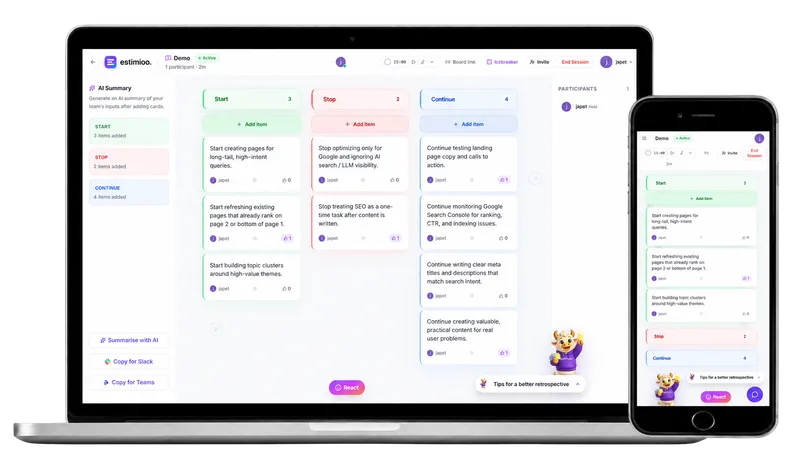
Templates· 42 retro formats, one click each (Start/Stop/Continue, Sailboat, Mad/Sad/Glad, 4Ls, Starfish, DAKI, Rose/Thorn/Bud, 5 Whys, Lean Coffee, Sprint Timeline and more) — counted in the shipped catalog, which holds 45 templates in total, three of which are Sprint Planning, Backlog Refinement and Daily Standup boards rather than retro formats. Marketing rounds this to "45 retro templates"Custom templates· Host can add, rename and remove columns, then Save as template to a personal My Templates list for reuse (signed-in hosts); the format can only be switched before anyone adds a cardAnonymous input· Host can make a whole retro anonymous at creation (names and avatars hidden on every card), or a participant can post a single card anonymously on a named board; the card record still carries the author's user ID, so authorship is hidden in the interface rather than unrecorded
Health checks
Health checks· In-session only: the Team Radar format has everyone score each dimension 1–10 with live averages, while the Team Health Check template is a column preset; no recurring cadence or trend across retrosTeam radars· Team Radar format plots the team's average 1–10 score per dimension as a live radar chart, one session at a timeMood / sentiment check· The AI retro summary gives each session one team-mood verdict (Positive / Neutral / Needs Attention), and Weather Report and Energy Levels are mood-themed column presets; nothing is tracked across retros
Facilitation
Meeting timer· Shared countdown with 2–25-minute presets, pause and resume; each facilitated phase (Writing, Voting, Discuss) can also start it at 2, 5 or 10 minutesAction items· Dedicated Action Items column plus Flag as action item on any card; an owner is picked from the participant list, and a signed-in user can save the flagged actions to a personal tracker with To Do / In Progress / Done status. Due dates exist only on items added in the trackerLink actions to ideas· Flagging keeps the action on its original card, and actions saved to the tracker record their source retro and cardDrag-and-drop groupingCarry over open actions· When the host opens a new retro, a banner lists open action items from previous retros with their owners; it draws on the host's personal tracker, so only actions the host saved there carry overFacilitator-only grouping· Grouping is always host-only — a participant's drag just reorders cards; not configurableAsync mode· A retro board can be left open for staggered input ahead of the live discussion (phases are optional), but Free sessions expire after 1 hour
Voting
Independent dot voting· Optional host-set budget of 3, 5, 7 or 10 votes per person with a votes-remaining counter (off by default, which means unlimited); one vote per card, and running tallies are visible to everyoneCustom vote count· Host picks a budget of 3, 5, 7 or 10 votes per person, or OffVote at any time· With phases off, voting stays open all session; once the host starts facilitated phases, voting is locked to the Voting phaseVote on ideas inside groups
Engagement
Mobile friendly· Browser-based; QR-code join for guestsROTI feedback· Leaving or ending a retro prompts "How was this retrospective session?" on a five-point emoji scale (Not great to Loved it!) with an optional comment; responses are stored with the retro, but no results view exists anywhere in the appTeam agreements· Working Agreements is one of the 42 retro formats — a column preset, not a persistent, revisitable agreements listIcebreakers· Every retro opens with a synced icebreaker drawn from 340+ questions — same question for every participant, host can shuffle, skippableGIFs· GIF picker (Klipy) in the in-session chat; GIFs can't be placed on cardsEmoji reactionsMusic· Twelve host-selectable audio tracks during a session — six synthesised ambient soundscapes (Café, Forest, Campfire, Deep Focus, Zen Drone, White Noise) plus six music beds (Sunshine jam, Uptempo funk, Smooth groove, Calm flow, Chill beats, Cosmic vibe)Planning poker· Core feature — Fibonacci, Modified Fibonacci, T-shirt, Powers of 2; hidden votes until reveal
AI
AI action items· An AI Action Items block with Add to board per item and a one-click Add all to board; the public demo returns a client-side mock rather than a live model call, so the quality of real suggestions could not be verified without an accountAI summary· One-click Claude summary per retro — team mood, per-column recap, key themes and ranked action priorities, with Re-summarise on paid; capped at one summary per retro on Free. Signed-in sessions post to a /api/ai-retro-summary endpoint, but the public demo substitutes a canned mockAI sentiment / heatmaps· The AI summary reports one team-mood verdict per retro (Positive / Neutral / Needs Attention) with a short rationale; nothing is tracked across retrosMetered AI (credits / quota)· Free: 5 AI estimates a month and one AI summary per retro; Team: 5 AI estimates per session; unlimited AI estimation only on the quote-only Enterprise tier
Enterprise
Facilitator-only role· Host-only controls: advance phases, group cards, set the vote budget, generate the AI summary, remove participants and end the session; in planning poker the host reveals votesGuest / observer roles· Guests join without signup by link or QR code, name only; only the host needs an accountMeeting history· Unlimited session history on Team; Free sessions expire after 1 hourLanguages· 5 (English, German, Spanish, French, Portuguese)